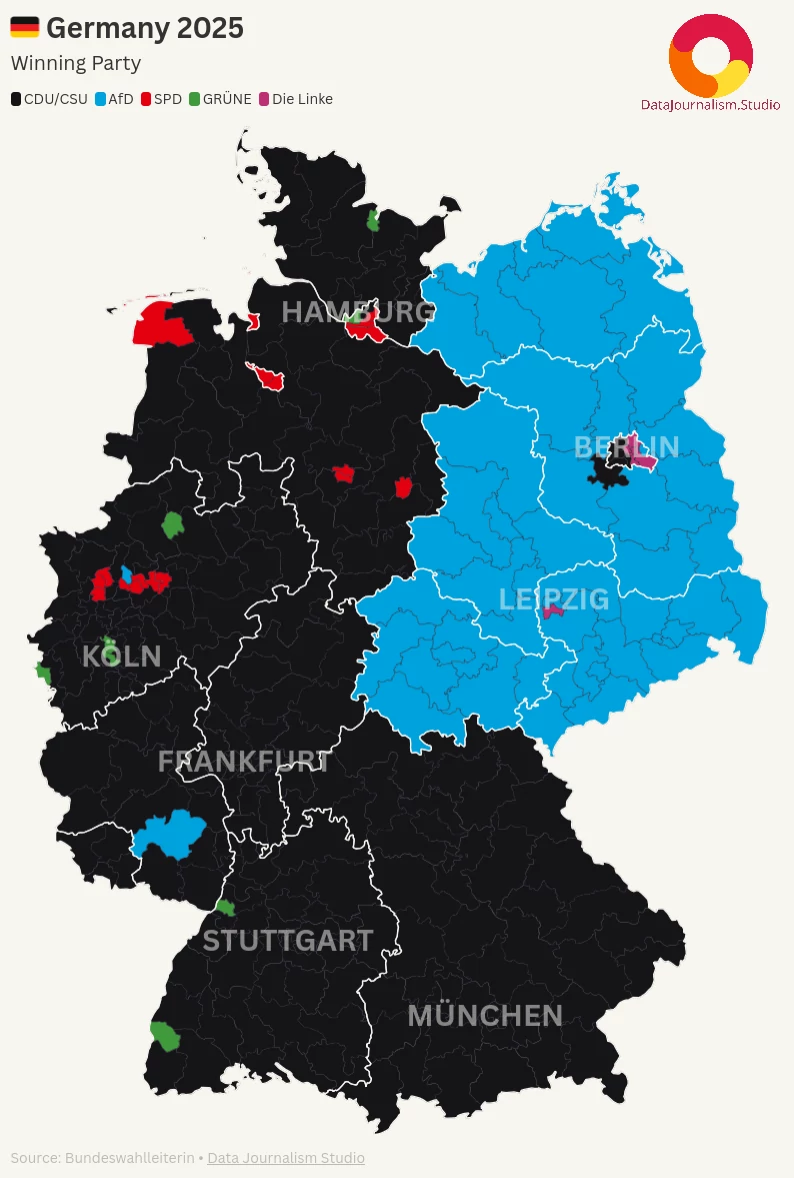
This is how the classic map display looks, reflecting the geographical area of regions - but large cities with large populations obviously don't have such an area, and the strength of their voters disappears in this image.
This map therefore logically shows mainly voters in smaller towns and rural areas.
Can you see the five-million-strong Berlin?
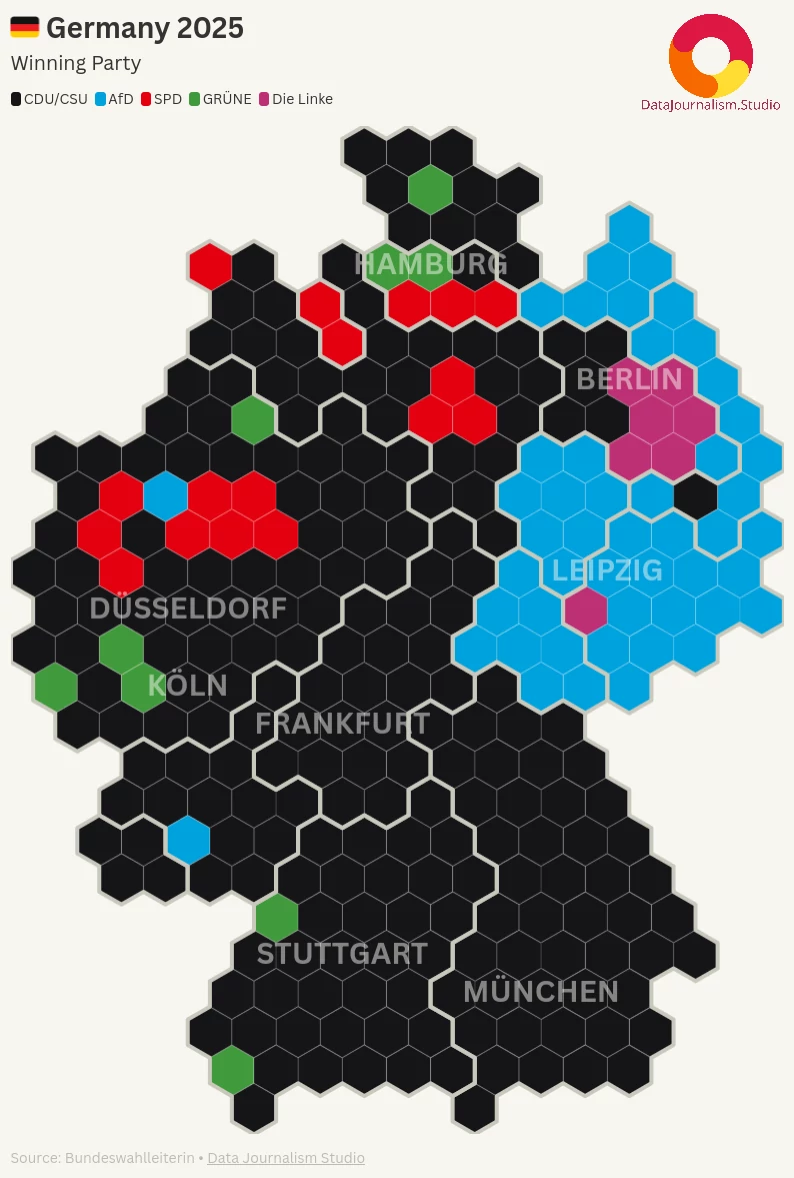
In this cartogram, the actual voting strength is displayed, not the geographical area. And the election results look quite different in it.
One hexagon ⬡ represents one electoral district. Each of these districts is roughly the same size and has approximately the same number of voters (about 200,000).
As you can see, it's not true that the part of Germany that experienced forty years of communist totalitarianism is now voting for the extreme right across the board.
In the largest cities – (eastern) Berlin or Leipzig – the left-wing Die Linke won instead.
In the west, many large cities also saw victories for SPD and the Greens:
e.g., Hamburg, the densely populated Ruhr area, Cologne (Köln) or Hannover.
Darker color means higher party support.
An interesting fact is that CDU/CSU are two parties. CDU (Christian Democratic Union) operates throughout Germany, except in Bavaria, where there is the independent CSU (Christian Social Union).
AfD was strongest in the east outside the largest cities.
The highest gains (over 45%) were in Saxon districts on the border with Czechia: Görlitz, Bautzen, in the area of Saxon Switzerland or in the Ore Mountains.
So what about that "radical Eastern Bloc"?
We can now see that with AfD, it's not about the entire former East Germany, as the "classic" electoral maps distortedly show, but only about a part of it.
But let's also look at the gains compared to the previous 2021 elections. Back then, AfD received 10.3% of the votes, this year it was 20.8%.
We'll highlight districts where AfD gained voters compared to the previous elections.
Which is all of them.
AfD gained new voters quite evenly across all of Germany.
The same map for the election winner CDU/CSU is not as clear-cut. Along with gains in most of Germany, they also lost in some eastern districts.
Explore specific districts and individual parties in the interactive cartograms below.
 German Parties